
Developing Programs That Minimize Noise Impacts On Surrounding Communities
For more than 40 years, the Port of Oakland has endeavored to develop programs that minimize noise impacts on surrounding communities. Noise abatement procedures (NAP) at Oakland San Francisco Bay Airport (OAK) are based on the voluntary actions that air traffic controllers and pilots may take to help reduce the impacts of aircraft noise on communities adjacent to the airport. The airport has no authority over the movement of aircraft or the direction of flight. The authority to regulate flight patterns of aircraft is vested exclusively in the Federal Aviation Administration (FAA).
The airport applies best practices to ensure disturbances are kept to a minimum, with training operations typically isolated to set periods and locations around the airport. The following are general guidelines and techniques we ask operators to follow to help minimize the noise impact produced by aircraft in your area.
North Field Touch & Go Noise Abatement

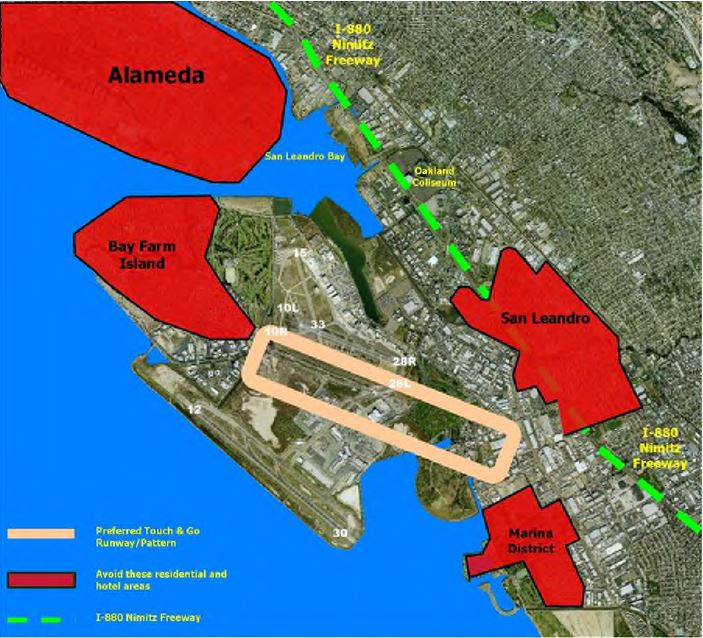
Touch & Go Residential Avoidance
At OAK, touch and goes are done using the North Field runways, usually on runways 28L or 28R.
When using runway 28R for touch and goes, the traffic pattern routes aircraft to take off to the north over Bay Farm island towards Alameda, turn right then travel south parallel to the runways over Oakland crossing towards San Landro, where they turn right again to line up and come in for a landing.
When using runway 28L, aircraft will also travel on their take off and landing legs over Bay Farm island and San Leandro, but the parallel leg of the traffic pattern is performed over the midfield portion of OAK.
Since the traffic pattern for runway 28L lies mostly over the airport rather than communities, runway 28L is the preferred runway for touch-and-goes for noise abatement purposes.
Please note that safety always takes precedence over noise abatement procedures and pilots must follow air traffic control instructions and other safety considerations caused by weather, potential air space conflicts, or emergencies.

Want to get more involved?